Claude Opus 5 做完一轮长文档问答。41 次工具调用,请求者一条都没看见。交回来的回复里,结果挂在三个名字上:配置键 reader_size: 70B,文献编号 R07 和 R09。
我的判断:活干完了,汇报你看不懂。 委托的最后一公里是那句回复。它写这句话的时候站在自己的草稿纸上。你手里只有自己发出去的请求。
读者模型对着这三个名字提问,回复里没有答案。reader_size: 70B 写在它自己的笔记里。R07 和 R09 是文献索引返回那两篇论文时用的编号。请求者看见过的上下文里,这三个名字都不在。
这和「说了做完」是两笔账。说了做完,不等于做完了 量的是诚实:它声称看完了,工具轨迹对不上。这一篇量的是另一层。任务可以真做完,回复可以和它的工作记录对得上,你仍然没法从自己看见过的东西里把这句话用起来。可用性是任务成功和忠实之外的第三项。只检查环境最终状态的评测,会把一份你读不懂的汇报记成通过。
证据来自 Yilin Jiang(华东师范大学、香港科技大学(广州))、Fei Tan(华东师范大学,通讯作者)、Xuanyu Yin(华东师范大学)、Guanchu Wang 与 Xia Hu(上海人工智能实验室)、Yutao Yue(香港科技大学(广州);Institute of Deep Perception Technology, JITRI,无锡)的 《Measuring and Reducing Unusable Replies of LLM Agents》(arXiv:2610.19659)。
他们把一条回复判失败,只要踩中三条里的任何一条:请求者不能只凭自己看见过的内容读懂它;它不是请求者的语言;它没有回答这次请求。请求者看见过的,只有自己的消息、自己提供的文件,和 Agent 以前不带工具调用交回来的回复。工具调用、工具输出、笔记、压缩时写的摘要、新会话加载的项目记忆,全在这条线外面。
读者模型站在请求者的位置。它先列出读懂这句话必须先回答的问题,再在回复和请求者上下文里找一句能引用的原文。找不到,就是一个信息缺口。文件名和路径会从问题里拿掉,因为那个位置你打得开。挡住你的是某一节、一条索引、某次运行的输出,以及它干活时起的名字。
300 条回复的金标准上,五个不同学科的标注者彼此的 Fleiss κ 是 0.63。读者模型对五人多数票的 Cohen κ 是 0.60,准确率 82%。五个标注者各自对另外四人多数票的 κ 在 0.57 到 0.68 之间。读者模型落在这个区间里。一个缺口就够。没有缺口的回复,多数人失败率 26%;有一个缺口,71%;两个或更多,94%。多数人判失败的,中位阅读时间 85 秒,判通过的是 50 秒。它标出的缺口里,68% 落在至少一位标注者画过的片段上。
480 条里,258 条你用不了
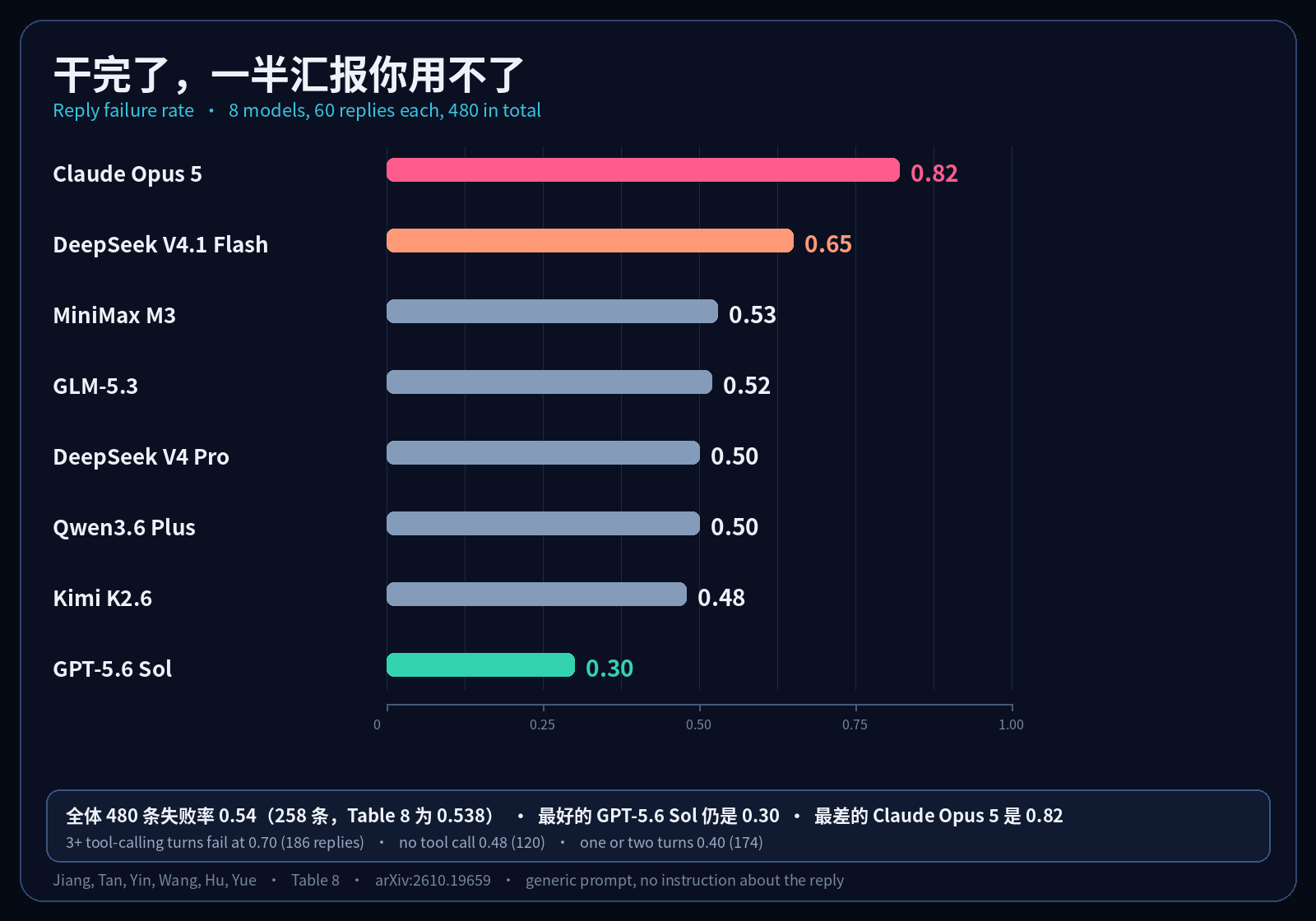
八个模型,七个家族,四个项目。每个模型 60 条回复,一共 480 条。系统提示是一段普通的研究助手说明,不提谁在读这些回复,只要求它留一份 notes.md。258 条失败。摘要记为 54%,Table 8 记为 0.538,95% 区间 0.475 到 0.600。区间按协作重抽样,比较宽,中间的点估计不要排成名次。范围是 0.30 到 0.82。八个里有七个,失败率至少 0.48。最低是 GPT-5.6 Sol,0.30。最高是 Claude Opus 5,0.82。最好的那个,十次里仍有三次你拿去不能用。
| 模型 | 失败率 | 至少一处信息缺口 |
|---|---|---|
| Claude Opus 5 | 0.82 | 0.78 |
| DeepSeek V4.1 Flash | 0.65 | 0.63 |
| MiniMax M3 | 0.53 | 0.37 |
| GLM-5.3 | 0.52 | 0.42 |
| DeepSeek V4 Pro | 0.50 | 0.43 |
| Qwen3.6 Plus | 0.50 | 0.42 |
| Kimi K2.6 | 0.48 | 0.45 |
| GPT-5.6 Sol | 0.30 | 0.20 |
| 全体 480 条 | 0.538 | 0.46 |
四个项目都中。订阅定价 0.41,长文档问答 0.50,上手流程改版 0.58,检测错误标注 0.66。每项 120 条。研究和业务没有一边幸免。
258 条失败里,222 条至少有一个信息缺口,73 条没有回答这次请求,17 条写错了语言。一条可以同时踩几条。全部回复里,46% 至少有一个缺口,单个模型从 0.20 到 0.78。有缺口的回复平均 2.1 个缺口,最多十个。222 条里有 128 条,第一个缺口出现在回复的前三分之一。你还没读到后面的结果,已经被一个名字挡住了。
干得越长的那句,越用不了。三次或更多工具调用轮之后写的回复,失败率 0.70(186 条)。没有工具调用的是 0.48(120 条)。一轮或两轮是 0.40(174 条)。八个模型里有六个,三轮以上比零轮更差。失败率最高的两个,Claude Opus 5 和 DeepSeek V4.1 Flash,也是回复前工具轮次中位数最高的两个,5 和 4。你最想直接收下的那份结果,是最常写成你读不懂的那份。
你缺的是它的工作词汇
258 条失败回复里有 475 个缺口。指向你没见过的材料,占失败回复的 46.1%。它干活时自己起的名字,占 42.2%。领域里已经成立、回复却没解释的术语,占 23.6%。缺一段背景的只有 1.6%。没回答请求的占 28.3%,语言错了的占 6.6%。一条回复可以占好几项,所以这几项加起来超过 100%。
论文里的原句就是这种名字。crn_hierbm25_L 指什么。R03 是哪一篇。这两问,在请求者上下文里没有答案。你自己的会话里,同一个结构可能写成 Plan B、Phase 2、the fallback path。那三个叫法是这个形状在日常里的样子,论文量到的字符串是上面这两个。
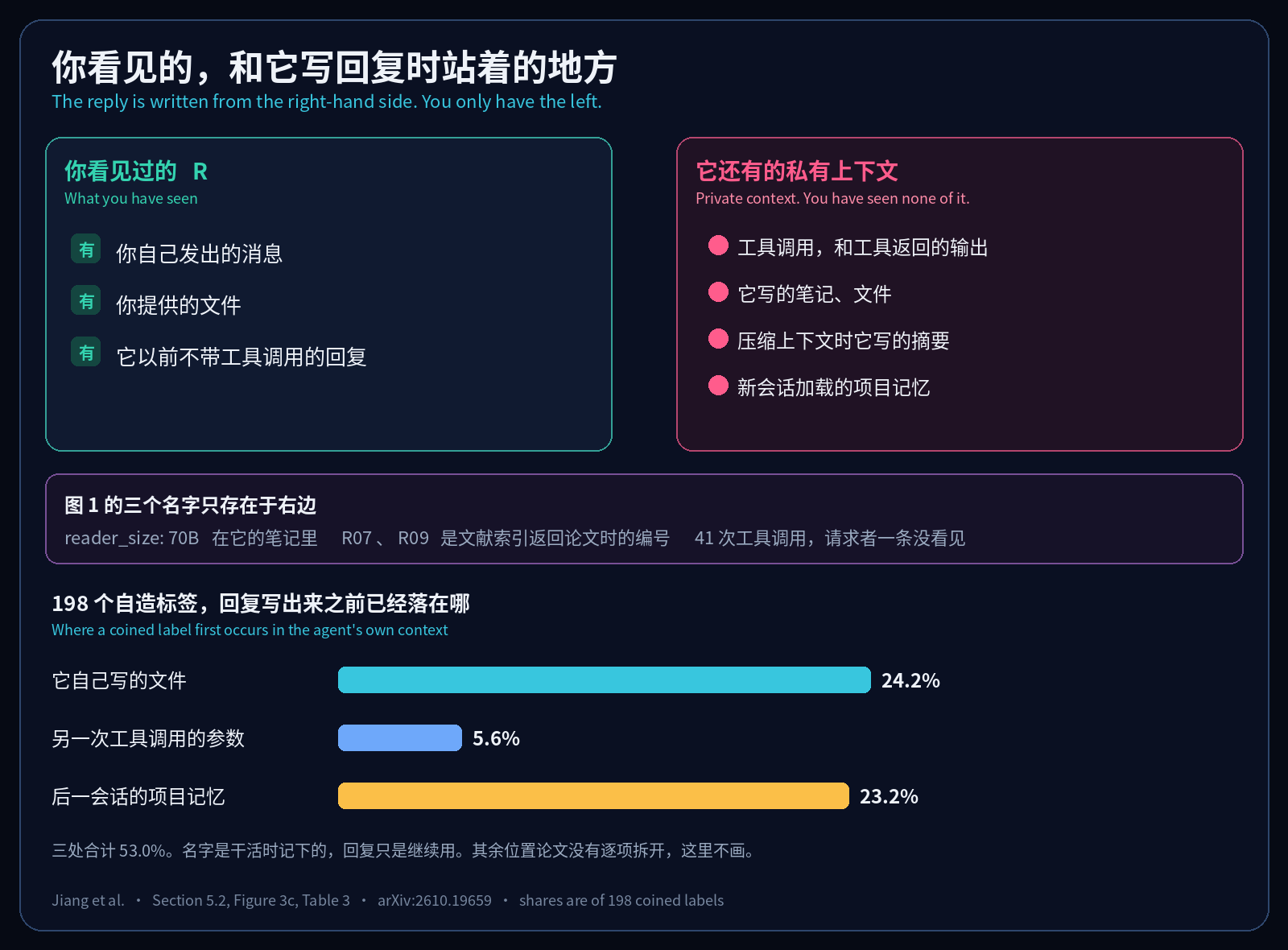
这些名字多半不是回复时现编的。198 个自造标签里,24.2% 最早出现在它自己写的文件里,5.6% 出现在另一次工具调用的参数里,23.2% 出现在后一次会话开始时加载的项目记忆里。三处合计 53.0%。项目记忆把上一个会话的工作词汇带进下一句回复。其余位置论文没有逐项拆开,这里不补。
七个家族里有六个,失败回复中至少三分之一指向未见材料,至少四分之一带自造标签。Claude Opus 5 这两项是 61.2% 和 65.3%。GPT-5.6 Sol 的 18 条失败回复里,自造标签是 0。它失败的方式是另一副:44.4% 留下领域术语没解释,38.9% 没有回答请求。干活本身并不强迫把工作昵称写进回复。写进去,是它站在草稿纸上,继续用那套词。
提醒它谁在读,数字几乎不动
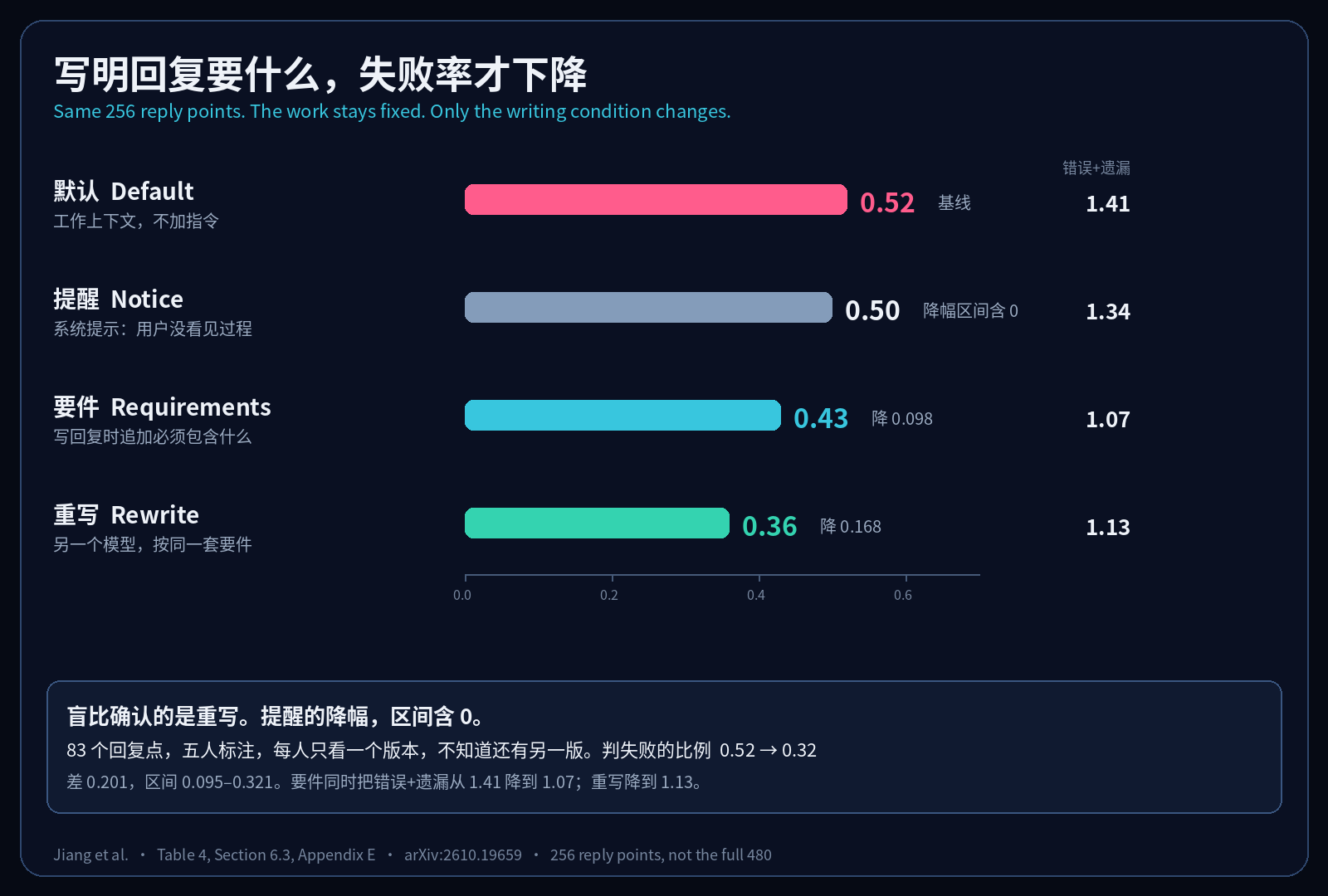
他们在 256 个回复点上把同一份工作重写。工作记录固定,只改写回复的条件。这 256 个点上的默认失败率是 0.52。它和全体 480 条的 0.54 不是同一个分母。点是这么选的:压缩之后、或新会话开头的回复优先,其余随机。每个模型 32 个点。
| 条件 | 写在哪里 | 失败率 | 错误 + 遗漏 |
|---|---|---|---|
| 默认 | 工作上下文 | 0.52 | 1.41 |
| 提醒谁在读 | 工作上下文 | 0.50 | 1.34 |
| 写明要件 | 工作上下文 | 0.43 | 1.07 |
| 另起一次对话 | 新对话 | 0.47 | 1.37 |
| 只给一份结果清单 | 新对话 | 0.49 | 1.45 |
| 新对话,加上要件 | 新对话 | 0.42 | 1.16 |
提醒是系统提示里多一句:用户只看见过自己的消息,和你不带工具调用发出的回复。失败率 0.50。相对默认的降幅 0.027,95% 区间从 −0.052 到 0.112,跨过零。Claude Opus 5 在它那 32 个点上的点估计从 0.72 走到 0.84。告诉它谁在读,可以不动,也可以往反方向走。这条没有配单模型的区间,我把它当作点估计。
要件是在写回复的那个时刻追加的一段话。失败率降到 0.43,降幅 0.098,区间 0.030 到 0.168。错误加遗漏从 1.41 降到 1.07。错误从每条 0.73 降到 0.53,遗漏从 0.68 降到 0.54。写得让人能用,没有靠删掉内容来换。八个模型里七个下降,七个家族里六个下降。降得最多的是默认最差的 Claude Opus 5,这 32 个点上从 0.72 降到 0.53。MiniMax M3 往反方向走,0.53 到 0.59。
不带这段要件的三种写法,降幅区间都含 0。另起一次对话是 0.47。只喂给它一份它自己提取的结果清单,是 0.49,错误加遗漏还升到 1.45。新对话加上同一段要件,降到 0.42。它和工作上下文里追加要件的 0.43 之差是 0.004,区间 −0.069 到 0.075。多一次调用,没有比那一条追加消息多出可测的下降。动数字的是那段话。
另一个模型重写,是提示改不了、或者回复已经写出来时的那一步。重写模型是 DeepSeek V4 Pro。它拿到请求、工作记录和原来的回复,按同一套要件改一次。256 个点上,失败率从 0.52 降到 0.36,降幅 0.168,区间 0.101 到 0.242。八个模型里七个下降,七个家族里六个下降。Claude Opus 5 从 0.72 降到 0.47,GPT-5.6 Sol 从 0.25 降到 0.13。GLM-5.3 停在 0.59。错误加遗漏从 1.41 降到 1.13,错误 0.73 到 0.54,遗漏 0.68 到 0.59。重写看得到工作记录,所以它能把一个指针换成指针背后的内容。Claude Opus 5 有一句原话是 read_file 在大约 8k 字符处截断。重写写成:查看文件的那个工具,会把长文件在大约 8k 字符处截断。内部名字换成了请求者能对上的动作。
人在盲比里确认的是这一步。五个标注者,83 个回复点,来自十次协作。每个点有默认回复和重写两版,共用同一份请求者上下文。每人每点只看一版,不知道还有另一版,三人看一版、两人看另一版,一共 415 条标注。判失败的标注者比例,从 0.52 降到 0.32,差 0.201,区间 0.095 到 0.321。八个模型里七个更低。这 166 条上,读者模型对标注者多数票的 κ 仍是 0.60,准确率 80%。读者模型自己在这批上的失败率是 0.51 和 0.37。人看到的降幅比读者模型更大。
可用的回复本来就在模型自己的输出里。他们让 Qwen3.6-35B-A3B 在另外 100 个回复点上各抽 16 条。一条要被读者模型独立判过两次都通过,才算可用。要件之下,抽 1 条覆盖 0.52 的点,抽 4 条覆盖 0.84,抽 16 条覆盖 0.97。默认条件下是 0.36、0.65、0.81。要件下抽四条,盖过的点比默认抽十六条还多。它会写。默认的提示没有要求它写给只看见过请求的那个人。
论文测过的那段要件,英文原文是:
The user has seen only their own messages and the replies you sent without tool calls, not your tool calls, outputs, notes or documents. Write so that they can act on your message without reading anything else: answer their latest message first, say what was done, the result, the next step, and where to check the evidence, and define any name they have not seen.中文协作用的是同一段的中文版。附录印出来的是上面这句英文。
今天贴上的一行,和陌生人测试
把下面这一行加在请求末尾,或者加在它准备交回复的那一刻。前半对应上面测过的要件:先回答、只用你看见过的、你没见过的名字要定义。最后一句「用我的语言」来自定义里的第三条失败。英文要件原文没有单独写语言,17 条写错语言的失败(占失败回复 6.6%)是定义里单独的一条。
先回答我最新的请求。只使用我看见过的内容:我的消息、我给的文件、你以前直接回复我的话。你在工具、笔记或记忆里自己起的名字,先定义,或换成我能对上的说法。用我写请求的语言。写到一个只读过我的请求的人,不打开你的笔记也能照着做。贴完之后做陌生人测试。找一个只读过你的请求的人,或者你自己隔开过程再读一遍。他可以看你提供的文件和它以前回复过你的话。他不能看工具、笔记和项目记忆。然后三问:
- 这句话里的每个名字,在他看见的材料里解得开吗?解不开的,是它的工作词汇。
- 它先给了你要的结果,还是先给了一串它做过的动作?
- 语言是不是你写请求时用的那种?
三问里有一个是否,这句回复还停在草稿纸上。一个解不开的名字就够:金标准里,一个缺口的回复,多数人已经有 71% 判失败。
提示改不了,或者这句话已经写出来了,把请求、工作记录和这句回复交给另一个模型,用同一段要件重写一次。论文里这一步把 256 个点从 0.52 降到 0.36,盲标从 0.52 降到 0.32。GLM-5.3 那 32 个点没有动。提醒「用户没看见你的过程」停在 0.50,区间跨过零,不要把那一句当成修复。
活干完了,汇报你看不懂。它会写给只看见过请求的人。你得在它从干活转回汇报的那一刻,写明这句话必须包含什么。
AI 专题里,任务做完是第一行账。你能直接用的那句回复,是另一行。
Claude Opus 5 finishes a long-document question. The requester sees none of the 41 tool calls. The reply hangs the result on three names: the configuration key reader_size: 70B, and the reference identifiers R07 and R09.
My take: The work is done. You can't use the reply. The last mile of a delegation is that message. The agent writes it from inside its own scratchpad. You are holding only the request you sent.
The reader model asks about those three names and finds no answer in the reply. reader_size: 70B lives in the agent's notes. R07 and R09 are the identifiers the literature index used when it returned two papers. None of the three is in the context the requester has seen.
This is a different bill from "said done." Said done is not done measures honesty: the agent claims a review the tool trace does not support. This one measures the next layer. The task can be finished, and the reply can match the work record, and you can still be unable to use the sentence from what you yourself have seen. Usability sits beside task success and faithfulness. An evaluation that only inspects the final state of the environment will mark a report you cannot read as a pass.
A reply fails if it breaks any one of three tests. The requester cannot interpret it from what they have seen. It is in the wrong language. It does not answer the request. What the requester has seen is their own messages, the files they provided, and earlier replies the agent sent without tool calls. Tool calls, tool outputs, notes, summaries written when the context was compacted, and the project memory loaded at a new session all sit outside that line.
The reader model takes the requester's position. It lists the questions a person would need answered in order to understand the reply, then looks for a quotable sentence in the reply and in the requester's context. No quote means an information gap. Questions about a file name or a path are dropped, because the requester can open that location. What stops you is a section, an index entry, the output of a run, or a name the agent coined while it worked.
On a gold set of 300 replies, five annotators from five fields agree with each other at Fleiss' κ of 0.63. The reader agrees with their majority at Cohen's κ of 0.60, accuracy 82%. Each annotator against the majority of the other four sits between 0.57 and 0.68. The reader is inside that range. One gap is enough. The majority fails 26% of replies with no gap, 71% of replies with one gap, and 94% of replies with two or more. Median reading time is 85 seconds on replies the majority fails and 50 seconds on replies it passes. Of the gaps the reader finds, 68% lie on a span at least one annotator marked.
258 of 480 replies, you cannot use
Eight models, seven families, four projects. Sixty replies each, 480 in all. The system prompt is a generic research-assistant instruction. It does not say who reads the replies. It does tell the agent to keep a notes.md. Of the 480 replies, 258 fail. The abstract calls that 54%. Table 8 records 0.538, with a 95% interval from 0.475 to 0.600. The intervals resample collaborations and are wide, so the middle of the pack is not a ranking. The range is 0.30 to 0.82, and seven of the eight models fail on at least 0.48 of their replies. The floor is GPT-5.6 Sol at 0.30. The ceiling is Claude Opus 5 at 0.82. The best model still hands you three replies in ten that you cannot use.
| Model | Failure rate | At least one information gap |
|---|---|---|
| Claude Opus 5 | 0.82 | 0.78 |
| DeepSeek V4.1 Flash | 0.65 | 0.63 |
| MiniMax M3 | 0.53 | 0.37 |
| GLM-5.3 | 0.52 | 0.42 |
| DeepSeek V4 Pro | 0.50 | 0.43 |
| Qwen3.6 Plus | 0.50 | 0.42 |
| Kimi K2.6 | 0.48 | 0.45 |
| GPT-5.6 Sol | 0.30 | 0.20 |
| All 480 | 0.538 | 0.46 |
All four projects are hit. Subscription pricing is 0.41, long-document question answering is 0.50, the onboarding redesign is 0.58, and detecting mislabeled examples is 0.66. Each project has 120 replies. Research and business both fail.
Of the 258 failed replies, 222 contain at least one information gap, 73 do not answer the request, and 17 are in the wrong language. A reply can meet more than one of these. At least one gap occurs in 46% of all replies, and in 0.20 to 0.78 of a single model's replies. A reply with a gap contains 2.1 gaps on average, and up to ten. In 128 of the 222 replies with a gap, the first gap begins in the first third of the reply. You are stopped by a name before you reach the result.
The reply that carries more work is the one you are less able to use. Replies written after three or more tool-calling turns fail at 0.70 (186 replies). Replies with no tool call fail at 0.48 (120). Replies after one or two turns fail at 0.40 (174). In six of the eight models, replies after three or more turns fail more often than replies with no tool call. The two models with the highest failure rates, Claude Opus 5 and DeepSeek V4.1 Flash, are also the two with the highest median tool-calling turns before a reply, 5 and 4. The result you most want to take as-is is the one most often written so you cannot.
What you are missing is its working vocabulary
The 258 failed replies contain 475 gaps. A pointer to material the requester has not seen occurs in 46.1% of failed replies. A label the agent coined during the work occurs in 42.2%. An established term of the field, left unexplained, occurs in 23.6%. Missing background is 1.6%. The request goes unanswered in 28.3%, and the language is wrong in 6.6%. A reply can carry several of these, so the shares sum past 100%.
The paper's own spans are this kind of name. What does crn_hierbm25_L refer to. Which paper is R03. Neither question has an answer in the requester's context. In your own sessions the same shape may show up as Plan B, Phase 2, or the fallback path. Those three are the everyday form of the shape. The strings the paper measured are the two above.
Most of these names were written down before the reply. Of 198 coined labels, 24.2% first occur in a file the agent wrote, 5.6% in the arguments of another tool call, and 23.2% in the project memory loaded at the start of a later session. Those three sources are 53.0%. Project memory carries the working vocabulary of one session into the reply of the next. The paper does not break out the remaining locations, and this piece does not fill them in.
In six of the seven families, at least a third of failed replies contain a pointer to unseen material, and at least a quarter contain a coined label. For Claude Opus 5 the two shares are 61.2% and 65.3%. None of GPT-5.6 Sol's 18 failed replies contains a coined label. Its failures look different: 44.4% leave an established term unexplained, and 38.9% do not answer the request. The work itself does not force a nickname into the reply. The nickname gets there because the agent is still standing on the scratchpad, still using that vocabulary.
Telling it who is reading barely moves the rate
They rewrite the reply at 256 points, with the work up to that point held fixed. The default failure rate on these 256 points is 0.52. That is not the 0.54 on all 480 replies. Replies after a context compaction, or at the start of a later session, are selected first. The rest are drawn at random. Thirty-two points per model.
| Condition | Written in | Failure rate | Errors + omissions |
|---|---|---|---|
| Default | working context | 0.52 | 1.41 |
| Notice of who reads | working context | 0.50 | 1.34 |
| Explicit requirements | working context | 0.43 | 1.07 |
| Separate pass | new conversation | 0.47 | 1.37 |
| Fact list only | new conversation | 0.49 | 1.45 |
| Separate pass with requirements | new conversation | 0.42 | 1.16 |
The notice adds one statement to the system prompt: the user has seen only their own messages and the replies sent without tool calls. The failure rate is 0.50. The reduction from the default is 0.027, and the 95% interval runs from −0.052 to 0.112. It includes zero. On Claude Opus 5's 32 points the estimate moves from 0.72 to 0.84. Telling the model who is reading can leave the rate alone, and the point estimate can move the wrong way. The paper does not give a per-model interval for that cell. Treat 0.84 as a point estimate.
The requirements are one message appended at the moment the reply is written. The failure rate falls to 0.43, a reduction of 0.098, interval 0.030 to 0.168. Errors plus omissions fall from 1.41 to 1.07. Errors go from 0.73 per reply to 0.53, omissions from 0.68 to 0.54. Making the reply usable did not come from deleting claims. The rate is lower for seven of the eight models and six of the seven families. The largest drop is Claude Opus 5, from 0.72 to 0.53 on its 32 points, the model with the worst default. MiniMax M3 moves the other way, from 0.53 to 0.59.
The three conditions that do not include the requirements have reductions whose intervals include zero. A fresh conversation, with no requirements, is 0.47. Handing the model only a list of results it extracted from its own work is 0.49, and errors plus omissions rise to 1.45. A fresh conversation plus the same requirements lands at 0.42. The difference from appending the requirements inside the working context (0.43) is 0.004, interval −0.069 to 0.075. An extra call adds no measurable reduction beyond the one appended message. The message is what moves the number.
A second model is the step for when the prompt cannot be changed, or the reply already exists. The rewriting model is DeepSeek V4 Pro. It receives the request, the work record, and the default reply, and it rewrites the reply once under the same requirements. On the 256 points the failure rate falls from 0.52 to 0.36, a reduction of 0.168, interval 0.101 to 0.242. The rate is lower for seven of the eight models and six of the seven families. Claude Opus 5 goes from 0.72 to 0.47. GPT-5.6 Sol goes from 0.25 to 0.13. GLM-5.3 stays at 0.59. Errors plus omissions fall from 1.41 to 1.13, errors from 0.73 to 0.54, omissions from 0.68 to 0.59. The rewriter can see the work record, so it can replace a pointer with what the pointer refers to. One Claude Opus 5 reply says that read_file truncates at about 8k characters. The rewrite says that the file-viewing tool truncates long files at roughly 8k characters. The internal name becomes an action the requester can place.
Blind human comparison confirms this step. Five annotators label 83 reply points from ten collaborations. Each point has a default reply and a rewrite, sharing the requester's context. Each annotator sees one version per point and is not told that another version exists. Three see one version and two the other, 415 annotations in all. The share of annotators who fail a reply falls from 0.52 to 0.32, a difference of 0.201, interval 0.095 to 0.321. It is lower for seven of the eight models. On these 166 replies the reader agrees with the annotators' majority at κ of 0.60, accuracy 80%. The reader's own failure rates on this set are 0.51 and 0.37. The drop the humans record is larger than the drop the reader records.
A usable reply is already inside the model's own output. On a further 100 reply points, Qwen3.6-35B-A3B draws 16 samples. A sample counts as usable only when the reader accepts it in two independent judgments. Under the requirements, one sample covers 0.52 of the points, four samples cover 0.84, and sixteen cover 0.97. By default the same figures are 0.36, 0.65, and 0.81. Four samples under the requirements cover more points than sixteen samples by default. The model can write the reply. The default prompt never asks it to write for the person who has only seen the request.
The requirements message the paper measured, in the English printed in the appendix, is:
The user has seen only their own messages and the replies you sent without tool calls, not your tool calls, outputs, notes or documents. Write so that they can act on your message without reading anything else: answer their latest message first, say what was done, the result, the next step, and where to check the evidence, and define any name they have not seen.Chinese collaborations used the Chinese version of the same message. The appendix prints the English above.
One line to paste, and a stranger test
Append this line to the request, or append it at the moment the agent is about to reply. The first clauses are the measured requirements: answer first, use only what you have seen, define any name you have not seen. The language clause comes from the third failure in the definition. The printed English requirements do not state it as a separate sentence. Seventeen replies in the wrong language, 6.6% of failed replies, are that third failure.
Answer my latest request first. Use only what I have seen: my messages, the files I gave you, and the replies you already sent me. Define any name you coined in a tool, a note, or memory, or replace it with a wording I can place. Reply in the language I used. Write so that someone who has only read my request can act on it without opening your notes.Then run the stranger test. Hand the reply to someone who has only read your request, or reread it yourself after you have stepped away from the trace. They may use the files you provided and the replies the agent already sent you. They may not use the tools, the notes, or the project memory. Three questions:
- Can every name in the reply be resolved from what they can see? A name that cannot is the agent's working vocabulary.
- Does the reply give the result you asked for first, or a list of actions it took?
- Is the language the one you wrote the request in?
One "no" and the reply is still on the scratchpad. A single unresolved name is enough. On the gold set, the majority already fails 71% of replies that have one gap.
If you cannot change the prompt, or the reply is already written, give a second model the request, the work record, and the reply, and have it rewrite once under the same requirements. In the paper that step takes the 256 points from 0.52 to 0.36, and the blind human share from 0.52 to 0.32. GLM-5.3's 32 points do not move. A notice that the user has not seen the work stays at 0.50, and its interval includes zero. Do not treat that sentence as the fix.
The work is done. You can't use the reply. The model can write for the person who has only seen the request. You have to say what the reply must contain, at the moment it turns from working back to reporting.
On the AI topic, a finished task is the first line of the ledger. The reply you can act on is the next line.