规划砍掉三成账单,准确率几乎不动。
团队给 coding agent 默认打开「规划」时,心里往往在买准确率。错了。对强模型,你买到的主要是停手纪律——少做改完之后那几轮重复验证,账单掉大约三成,分数几乎不动。
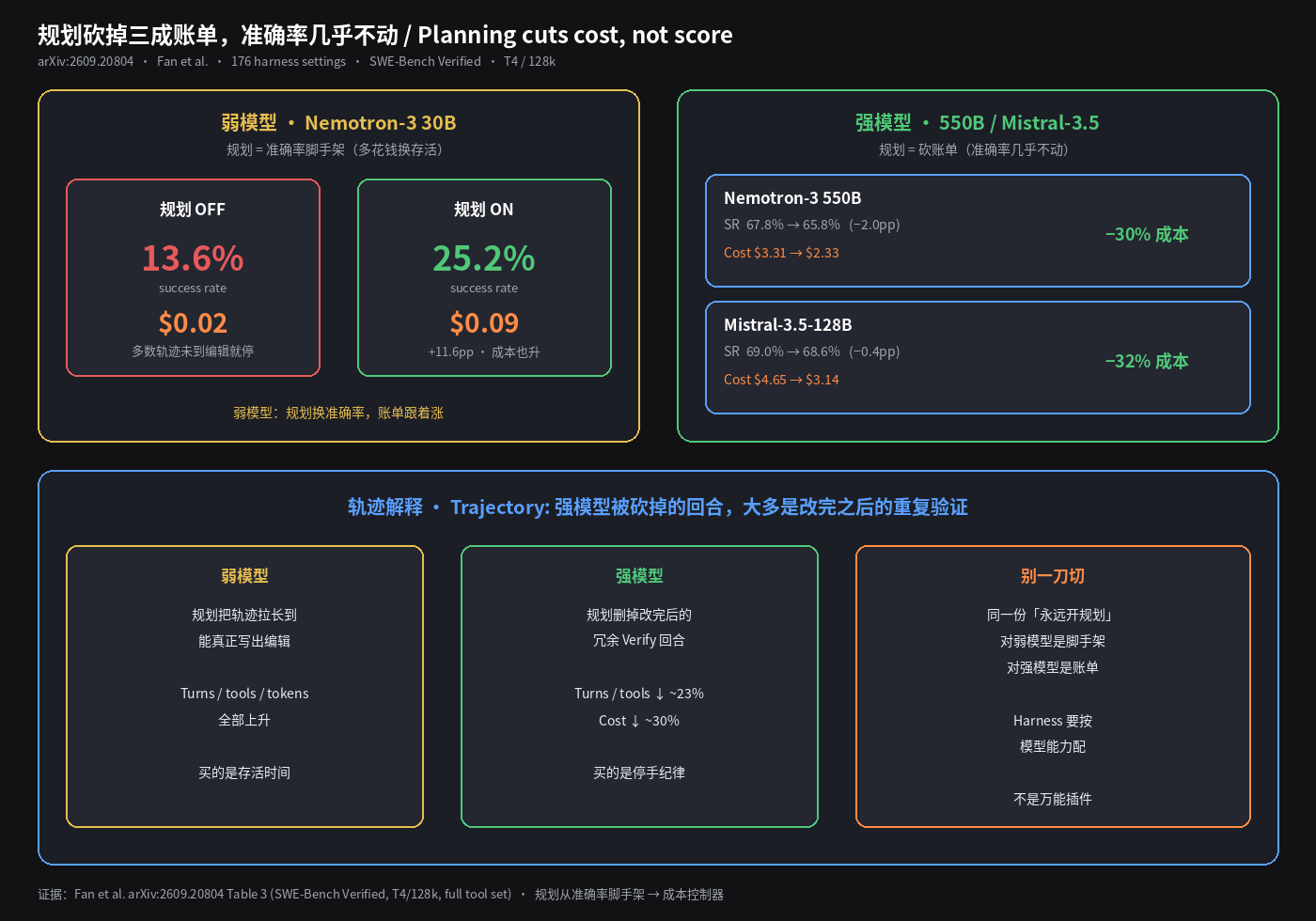
同一开关,两种经济学
Fan 等(arXiv:2609.20804) 把 coding harness 拆成可独立消融的三块——规划、动作空间、上下文管理——在 SWE-Bench Verified 与 Terminal-Bench 2.1 上跑了 176 组对照。固定执行循环,只拧其中一个旋钮。
在 T4 / 128k、全工具集这一格,规划的效果按模型能力翻面:
| 模型 | 规划 OFF → ON | 成本变化 | 你买到了什么 |
|---|---|---|---|
| Nemotron-3 30B(弱) | 13.6% → 25.2%(+11.6pp) | $0.02 → $0.09 | 存活到能写出编辑 |
| Nemotron-3 550B(强) | 67.8% → 65.8%(−2.0pp) | $3.31 → $2.33(≈−30%) | 砍掉改后 Verify |
| Mistral-3.5-128B(强) | 69.0% → 68.6%(−0.4pp) | $4.65 → $3.14(≈−32%) | 同上 |
弱模型:规划把回合、工具调用、输入 token 一起拉长——Nemotron-3 30B 在 SWE-Bench 上 turns +293%、tool calls +474%。贵,但贵得有道理:没规划时大量轨迹在编辑前就熄火。
强模型:规划让回合与工具调用下降大约 23%–24%。被拿掉的,论文轨迹分析写得很清楚——多半是改完之后的重复验证,不是定位与修复本身。准确率几乎不动,甚至略降;便宜的是「别再验一遍」的纪律。
别把脚手架焊成默认
「永远开规划」听起来像工程美德。数据说它是按能力翻转的旋钮:对弱模型是准确率脚手架,对强模型是成本控制器。继续一刀切,等于用弱模型时期的教条给强模型烧钱。
附带两记更刺耳的同论文结果,免得你只改规划、忘了整副 harness:
- 可回滚记忆几乎没人用:在 64 组开了 recall 的设定里,56.3% 从未调用
recall_event;相对纯 elision,准确率没有增益。 - 会 bash 的强模型,工具箱不一定更赚:Nemotron-3 550B 在 bash-only 下 SWE-Bench 成功率 69.4%、成本 $1.11,对比全工具 65.8% / $2.33——更准,且差不多半价。Mistral 则相反。动作空间也要模型感知,不是「工具越多越好」。
今晚只拧一个旋钮
别再把「规划 ON」当成所有 agent 的默认信仰。今晚做一件可运行的事:按模型档位拆开 harness 配置——弱模型保留规划当脚手架;强模型做一次 plan-off / plan-on 的成本对照(同任务集、同窗口),看账单掉多少、分数动不动。若强模型侧成本掉三成而分数几乎不动,你之前付的不是准确率,是改完之后的 OCD。
判断很简单:规划不是万能插件;它是模型能力的函数。
Planning cuts the bill thirty percent; accuracy barely moves.
When teams turn planning on by default for coding agents, they think they are buying accuracy. Wrong. On strong models, what you mostly buy is the discipline to stop — fewer redundant post-edit verification turns, about thirty percent off the bill, score almost flat.
Same switch, two economics
Fan et al. (arXiv:2609.20804) dissect the coding harness into independently ablatable pieces — planning, action space, context management — across 176 matched settings on SWE-Bench Verified and Terminal-Bench 2.1. Execution loop fixed; one knob at a time.
Under T4 / 128k with the full tool set, planning flips sign with model strength:
| Model | Plan OFF → ON | Cost change | What you bought |
|---|---|---|---|
| Nemotron-3 30B (weak) | 13.6% → 25.2% (+11.6pp) | $0.02 → $0.09 | Survive long enough to edit |
| Nemotron-3 550B (strong) | 67.8% → 65.8% (−2.0pp) | $3.31 → $2.33 (≈−30%) | Cut post-edit Verify |
| Mistral-3.5-128B (strong) | 69.0% → 68.6% (−0.4pp) | $4.65 → $3.14 (≈−32%) | Same |
Weak models: planning stretches turns, tool calls, and input tokens together — Nemotron-3 30B on SWE-Bench shows turns +293%, tool calls +474%. Expensive, for a reason: without planning, many trajectories die before an edit.
Strong models: planning cuts turns and tool calls by roughly 23–24%. Trajectory analysis is blunt about what disappears — mostly redundant post-edit verification, not localize-and-fix. Accuracy barely moves, sometimes dips; the cheap thing is the habit of not re-checking.
Stop welding the scaffold into the default
“Always-on planning” sounds like engineering virtue. The data says it is a capability-flipped knob: accuracy scaffold for weak models, cost controller for strong ones. One default for all is paying a weak-model doctrine on a strong-model bill.
Two sharper co-findings from the same paper, so you do not retune only planning and ignore the rest of the harness:
- Reversible memory is mostly unused: among 64 settings with recall enabled, 56.3% never call
recall_event; no accuracy gain over elision alone. - Bash-capable strong models do not always win with a tool zoo: Nemotron-3 550B under bash-only hits 69.4% on SWE-Bench at $1.11, versus 65.8% / $2.33 with the full tool set — higher score, roughly half the cost. Mistral flips the other way. Action space is model-aware too; more tools is not always better.
Twist one knob tonight
Stop treating “planning ON” as the default creed for every agent. Do one runnable thing tonight: split harness configs by model tier — keep planning as a scaffold on weak models; on strong models, run a plan-off / plan-on cost A/B on the same task set and window. If cost drops ~30% and the score barely moves, you were not paying for accuracy. You were paying for post-edit OCD.
The judgment is simple: planning is not a universal plugin; it is a function of model capability.