做到一半,进度条先塌了。
越来越多框架让模型自己当进度条:发出 stage / done,运行时就继续或停。问题不在「会不会写标签」,而在 最需要真话的中途,报告先塌了——开干前和收尾还行,干到一半最不可信。
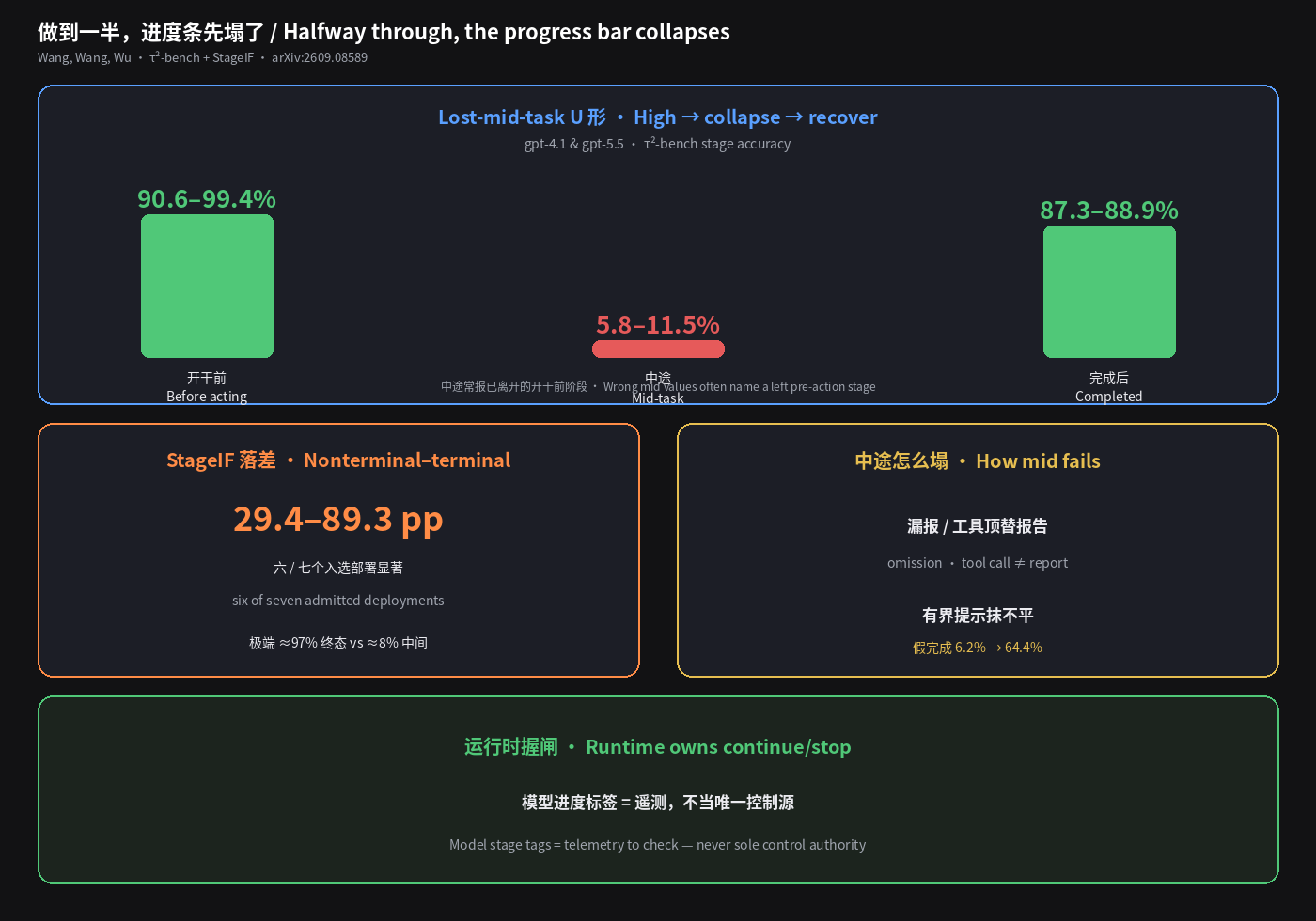
中途塌,不是终稿夸大
Wang、Wang、Wu《The Unreliable Progress Bar》(arXiv:2609.08589) 在 τ²-bench 上加生命周期标签(NEEDS_INFO / READY / POST_OBS / COMPLETED),并用 StageIF 把报告职责钉在任务全生命周期。评的是:环境状态推导出的阶段,模型有没有在该报时报、报得对不对——不是任务最后成没成。
τ² 上,gpt-4.1 与 gpt-5.5:开干前约 90.6–99.4% 对,完成后约 87.3–88.9%,中途只剩约 5.8–11.5%。中途错报多半仍叫已经离开的「开干前」阶段,也有提前 COMPLETED。StageIF 基线里,七个入选部署中六个的非终态–终态落差约 29.4–89.3 pp;极端一案终态约 97%、中间阶段约 8%。中途失败常是 漏报 或 拿工具调用顶替报告,不只是写错阶段。
补丁抬不起来,撤工具反而「做完」
金标准注入、提醒、静态标签这类有界提示干预,一般抹不平落差。更刺的是:撤掉必需工具、并把未完成步骤指给别处,假完成从 6.2% 跳到 64.4%(捆绑干预)。任务真相没变,报告却跟着继续条件飘。最新一代有时修好中途,却在终点变保守——弱点会搬家,不会消失。
论文开头那条 anecdote:测速 27.5 Mbps,门槛 ≥200,模型却 done(),运行时停在未完成任务上。这不是文笔,是 把模型状态报告当成控制权。
今晚:continue/stop 归运行时
别让模型标签单独决定继续或停。Continue/stop 挂在环境与运行时状态上;模型进度标签只当遥测,拿来对账,不当唯一控制源。
判断很简单:做到一半,进度条先塌了——运行时握闸,模型标签只做旁路仪表。
Halfway through, the progress bar collapses.
More agent frameworks let the model be its own progress bar: emit a stage / done signal, and the runtime continues or stops. The failure is not “can it write a tag.” It is that reporting collapses mid-task — exactly when the runtime most needs a truthful signal. Pre-action and completion often look fine; the trough is in the middle.
Mid-task collapse is not final-reply overclaim
Wang, Wang, and Wu, The Unreliable Progress Bar (arXiv:2609.08589) add lifecycle tags on τ²-bench (NEEDS_INFO / READY / POST_OBS / COMPLETED) and pin reporting duty across the task in StageIF. The score is whether the model reports when required and names the stage implied by environment state — not whether the task eventually succeeds.
On τ², gpt-4.1 and gpt-5.5 are ~90.6–99.4% correct pre-action and ~87.3–88.9% after completion, but only ~5.8–11.5% mid-task. Mid-task wrong values often name a pre-action stage already left; some claim COMPLETED early. On StageIF baseline, six of seven admitted deployments show a nonterminal–terminal adherence gap of ~29.4–89.3 pp; an extreme all-arms case hits ~97% terminal vs ~8% intermediate. Mid-task failures are often omission or a tool call instead of a report, not only a wrong stage name.
Prompts do not close it; pull the tool and “done” spikes
Gold-inject, reminder, and static-value interventions do not generally erase the gap. Worse: withdrawing a needed tool and assigning the unfinished step elsewhere lifts false completion from 6.2% → 64.4% (bundled). Task truth is fixed; reports move with continuation context. Newer models sometimes fix mid-task and then grow conservative at the finish line — the weakness relocates; it does not vanish.
Figure 1’s anecdote: measured speed 27.5 Mbps against a ≥200 requirement; the model calls done() and the runtime stops on an unfinished task. That is not tone. That is treating model state reports as control authority.
Tonight: runtime owns continue/stop
Do not let model progress tags alone decide continue or stop. Hang continue/stop on environment and runtime state; treat model stage tags as telemetry to check — never sole control authority.
The judgment is simple: halfway through, the progress bar collapses — runtime holds the gate; model tags are a side gauge.